


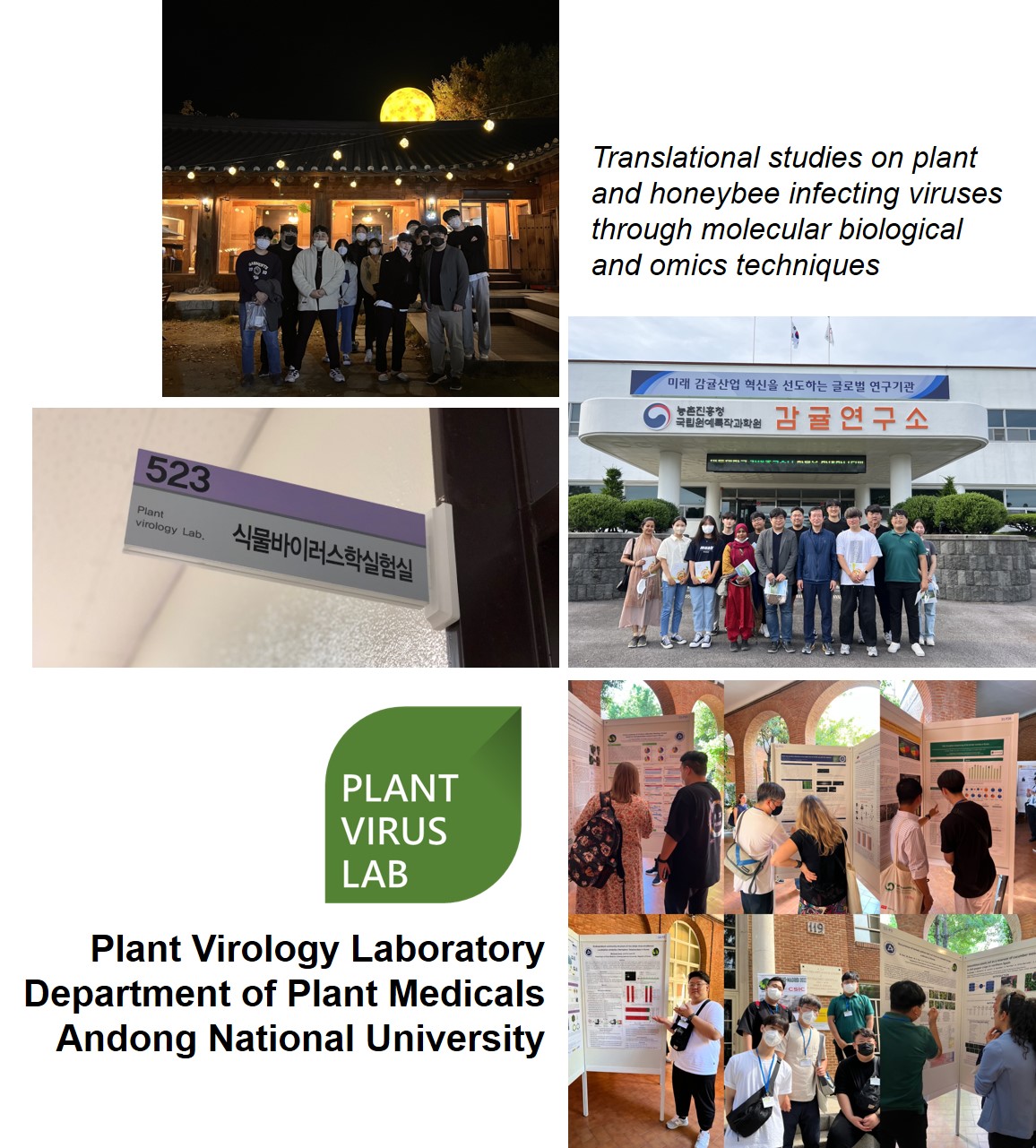
Virology Lab (바이러스학연구실 / Room 408/409)
PI: Prof. Dr. Eui-Joon Kil (지도교수: 길의준 교수)
Website: https://plantvirus7.wixsite.com/virus
Website: https://plantvirus7.wixsite.com/virus
Our laboratory focuses on virology, molecular biology, bioinformatics, and agricultural biotechnology, emphasizing the diagnosis, characterization, and management of emerging viruses. We extensively investigate virus-host interactions, transmission mechanisms, and epidemiology using advanced molecular and genomic techniques. Collaborative research both domestically and internationally strengthens our efforts to proactively manage virus threats, ensuring agricultural sustainability and productivity.
본 연구실은 바이러스학, 분자생물학, 생물정보학 및 농업생명공학 분야를 중심으로 신규 바이러스 진단, 특성 분석 및 방제 연구를 수행하고 있습니다. 바이러스-기주(숙주) 간 상호작용, 전염 메커니즘 및 역학을 분자생물학 및 유전체학 기반의 첨단 기술로 분석하며, 국내외 공동연구를 통해 선제적으로 바이러스 위협을 관리함으로써 지속 가능한 농업 발전에 기여하고 있습니다.
본 연구실은 바이러스학, 분자생물학, 생물정보학 및 농업생명공학 분야를 중심으로 신규 바이러스 진단, 특성 분석 및 방제 연구를 수행하고 있습니다. 바이러스-기주(숙주) 간 상호작용, 전염 메커니즘 및 역학을 분자생물학 및 유전체학 기반의 첨단 기술로 분석하며, 국내외 공동연구를 통해 선제적으로 바이러스 위협을 관리함으로써 지속 가능한 농업 발전에 기여하고 있습니다.
Current Members (현재 구성원)
-
- Dr. Aamir Lal
- Dr. Muhammad Amir Qureshi
- 김민서 / Minseo Kim
- 곽명환 / Myeonghwan Kwak
- 강정훈 / Jeong Hun Kang
- 전지호 / Ji Ho Jeon
- 권민혁 / Minhyeok Kwon
- 손만철 / Mancheol Son
- Paradha Nonthijun
- 장소윤 / So Yun Jang
- 오기준 / Gijun Oh
- 진석호
- 김다소 / Daso Kim
- 박지오 / Jio Park
- Sajede Khalili (University of Tehran)
Research Professor / Post-doctoral Researcher
Doctoral Course
Master Course
Undergraduate
Researcher
Visiting Scholar
Research Funds (연구과제)
- 유입우려 고위험 종자전염 바이러스 위험 분석 및 관리기반 구축 (농촌진흥청, 2020-2024) - 서울대학교, 충북대학교, 국립농업과학원 공동연구
- 총채벌레 행동생리 기반 고효율 유인제 개발 및 밀도변동 분석을 통한 친환경 방제기술 개발 (농촌진흥청, 2021-2023) - 자대 김용균교수 연구팀, 경상국립대학교, 오상킨섹트, 국립농업과학원 공동연구
- 기후변화에 의한 벼 병원체 증식, 변이분석 및 피해저감 연구 (농촌진흥청, 2021-2024) - 경북대학교, 전북대학교, 국립식량과학원 공동연구
- 골드나노파티클 구조 기반 고추 및 토마토 감염성 DNA 및 RNA 바이러스 분자진단 방법 개발 (IPET, 2021-2022) - 성균관대학교, 바이오에프디엔씨 공동연구
- 병징 발현 양상이 상이한 TYLCV 분리주들을 이용한 식물 바이러스 병징 발현 기작 연구 (한국연구재단, 2020-2023) - 단독연구
- 이공분야 대학중점연구소 (한국연구재단, 2021-Present) - 국립경국대학교 농업과학기술연구소 공동연구
- 산림과수 감염 바이러스 최적 진단법 탐색 (국립산림과학원, 2022) - 위탁연구과제용역
- 우즈베키스탄 스마트 양봉 생산성과 강건성 증진 통합관리 기술 개발 사업 (한국연구재단, 2022-2025) - 자대 정철의교수 연구팀, 비해피양봉조합 공동연구
- 천궁 바이러스병 매개곤충(총채벌레)과 기주 상관관계 조사 (국립산림과학원, 2023) - 위탁연구과제용역
- 경북지역 꿀벌바이러스병 발생 현황 조사 및 대응 방안 연구 용역 (경상북도의회, 2023) - 위탁연구과제용역
- 국내 주요 발생 꿀벌 바이러스에 대한 접종 프로토콜 및 이를 활용한 항바이러스물질 탐색 시스템 개발 (한국연구재단, 2023-2026) - 단독연구
- 검역바이러스 유전자원 수집 및 표준물질 제작 기술 개발 (농림축산검역본부, 2024-Present) - 성균관대학교 공동연구
- 식물 바이러스병 모니터링 및 진단 방제연구 (한국농업기술진흥원, 2025-Present) - 경북대학교, 서울대학교, 강원대학교, 전남대학교, 전북대학교, 충북대학교 등 공동연구
- 콩 복합감염병 및 신문제 나방류 현장 방제기술 개발 (농촌진흥청, 2025-Present) - 자대 임언택교수 연구팀, 국립식량과학원 공동연구
- 유입우려 고위험 식물 바이러스병 확산 방지 기술 개발 (농촌진흥청, 2025-Present) - 서울대학교, 성균관대학교, 강원대학교, 국립농업과학원 공동연구
- 아시아 베고모바이러스 바이롬(Virome)의 재조합 기반 모듈식 진화 기작 규명과 이를 활용한 멀티모달 AI 기반 출현 위험도 평가 프레임워크(ReDES) 개발 (한국연구재단, 2026-Present) - 단독연구
Research Topics (연구주제)
1. Investigation and characterization of emerging ssDNA viruses associated with subtropical crop introduction
Due to climate change and the need to develop new income sources for farmers, the cultivation of tropical and subtropical crops in Korea has been expanding. Accordingly, ssDNA viruses are continuously introduced into Korea alongside crops mainly imported from Southeast Asia. Recent outbreaks of novel ssDNA viruses such as EuLCV, PaLCuCNV, and PaLCGdV have been identified during the cultivation of papaya and passion fruit, prompting active research on their pathological characteristics, including host range and transmission properties. International collaborations with research teams from Italy, Japan, Thailand, Bangladesh, Pakistan, Indonesia, and Vietnam have also been conducted to proactively characterize viruses with high potential for introduction into Korea.
기후 변화와 농가의 새로운 소득원 발굴로 인해 국내에서 열대 및 아열대 작물의 재배가 확대되고 있다. 이에 따라 주로 동남아시아 지역에서 도입된 작물과 함께 ssDNA 바이러스의 국내 유입이 지속적으로 확인되고 있다. 최근 파파야와 패션프루트 재배 과정에서 MDV, EuLCV, PaLCuCNV 및 PaLCGdV와 같은 신규 ssDNA 바이러스가 국내에 유입되어 병리적 특성(기주 범위, 전염 특성 등)에 대한 연구가 활발히 진행되고 있다. 특히 이탈리아, 일본, 태국, 방글라데시, 파키스탄, 인도네시아, 베트남 등의 연구팀과 국제 공동연구를 수행하여 향후 국내 유입 가능성이 높은 바이러스의 특성 규명을 통해 선제적으로 대응하고 있다.
2. Analysis of transmission mechanisms for ssDNA viruses
The transmission of plant viruses primarily occurs via insect vectors, but seeds and plant sap from infected plants can also serve as inoculum sources. Recently, novel seed-transmitted ssDNA viruses such as TYLCV, ToLCNDV, SPLCV, and PepYLCIV have been identified. Current research focuses on elucidating the plant factors influencing seed transmission. Additionally, the specificity of insect vector-mediated transmission by certain insect biotypes or quasispecies, influenced by microbial communities within vectors, is under extensive study.
식물 바이러스의 전염은 주로 곤충 매개체를 통해 이루어지며, 감염된 식물의 종자 및 수액 또한 전염원이 될 수 있다. 최근 TYLCV, ToLCNDV, SPLCV, PepYLCIV 등 ssDNA 바이러스가 신규로 종자를 통해 전염되는 것으로 확인되었다. 본 연구는 종자 전염 과정에서 작용하는 식물 인자 규명에 초점을 맞추고 있다. 또한 특정 곤충 생태형이나 준종(quasispecies)에 의한 곤충 매개 전염 특이성 및 매개체 내 미생물 군집이 바이러스 전염 효율에 미치는 영향에 대한 연구도 활발히 진행 중이다.
3. Analysis of interactions between ssDNA viruses and host plants
Effective virus control requires an understanding not only of the virus itself but also of the insect vectors and host plants involved. Weeds and alternative crops can serve as intermediate hosts facilitating virus spread. Research is being conducted on the infection patterns of naturally occurring weeds in Korea and their life cycles in relation to virus infection. Even within the same virus species, minor genetic differences can result in varied symptom expressions. Studies using natural mutants and artificially point-mutated viruses have actively reported mechanisms of symptom expression. Moreover, research is underway to identify key factors in virus-resistant plants that inhibit viral replication.
바이러스 방제는 바이러스 자체뿐 아니라 전염 매개체인 곤충 벡터와 기주식물에 대한 이해를 필수적으로 요구한다. 주요 작물이 아닌 잡초 및 타작물이 중간기주로서 바이러스 확산에 기여할 수 있어 국내 자연 발생 잡초들의 바이러스 감염 양상 및 생활사와의 연관성을 연구하고 있다. 동일한 바이러스 종 내에서도 유전자 서열의 미세한 차이에 따라 증상 발현 양상이 다르게 나타날 수 있으며, 자연적으로 발생한 돌연변이체 및 인위적 점 돌연변이 바이러스를 이용한 증상 발현 메커니즘 분석이 최근 논문을 통해 활발히 보고되고 있다. 또한, 바이러스에 내성을 보이는 식물에서 바이러스 복제를 억제하는 주요 인자 규명 연구도 진행 중이다.
4. Development and utilization of ssDNA virus infectious clones and establishment of a virus repository
ssDNA viruses are primarily transmitted by insect vectors such as whiteflies and are generally difficult to inoculate mechanically. To facilitate virus studies, infectious clones are developed by cloning virus genomes into binary vectors and transforming them into Agrobacterium, enabling efficient plant inoculation. Recent work includes establishing infectious clones for various domestic and international ssDNA viruses, such as EuLCV, ToLCNDV, PaLCGdV, and TYLCV, providing essential tools for functional genomics research, symptom analysis, and resistance breeding programs. This work contributes significantly to establishing an extensive ssDNA virus repository for broad research applications.
ssDNA 바이러스는 주로 가루이와 같은 곤충 벡터에 의해 전염되며, 일반적으로 기계적 접종이 어렵다. 바이러스 연구를 용이하게 하기 위해 바이러스 게놈을 바이너리 벡터에 클로닝한 뒤 아그로박테리움에 형질전환하여 식물 감염이 가능한 감염성 클론을 개발하고 있다. 최근 국내외 ssDNA 바이러스(EuLCV, ToLCNDV, PaLCGdV, TYLCV 등)에 대한 감염성 클론을 구축하여 기능 유전체학 연구, 증상 분석 및 저항성 육종 프로그램에 필수적인 도구를 제공하고 있다. 이러한 작업은 광범위한 연구 응용을 위한 ssDNA 바이러스 은행 구축에 크게 기여하고 있다.
5. Molecular diagnostics and virome analysis
Rapid and precise diagnostic methods for plant viruses are essential for effective disease management. Research focuses on developing field-deployable diagnostic systems using nucleic acid amplification techniques such as Loop-mediated isothermal amplification (LAMP) and Recombinase polymerase amplification (RPA). Additionally, diagnostic kits using recombinant scFv antibodies, selected via phage display and expressed in E. coli, are under development. Virome analysis employing next-generation sequencing technologies is also performed to comprehensively understand virus communities in plants and insect vectors.
식물 바이러스의 신속하고 정확한 진단은 효과적인 질병 관리에 필수적이다. 현장에서 사용 가능한 핵산 증폭 기반의 LAMP 및 RPA 기술을 활용한 진단 시스템 개발을 진행하고 있다. 또한, phage display 기술을 이용해 선별된 scFv 항체 단백질을 활용한 진단 키트 개발도 이루어지고 있다. 차세대 염기서열 분석 기술을 이용한 바이롬 분석을 통해 식물과 곤충 매개체 내 바이러스 군집에 대한 심층적 연구도 수행 중이다.
6. Honey bee virus analysis
Honey bees, crucial pollinators, also transmit plant viruses. Research aims to profile and understand virus diversity and dynamics within honey bee populations. Recent studies using high-throughput sequencing provide insights into virus ecology, evolution, and impacts on bee health, supporting sustainable agricultural practices.
꿀벌은 중요한 수분 매개자이면서 식물 바이러스를 전염시키는 역할도 한다. 본 연구는 꿀벌 개체군 내 바이러스의 다양성과 동태를 분석하고 이해하는 데 초점을 맞추고 있다. 최근 고속 염기서열 분석을 통해 바이러스 생태, 진화 및 꿀벌 건강에 미치는 영향에 대한 연구를 진행하여 지속가능한 농업 실천을 지원하고 있다.